2024, the year of the mildew
Autumn 2024 — 3 min read
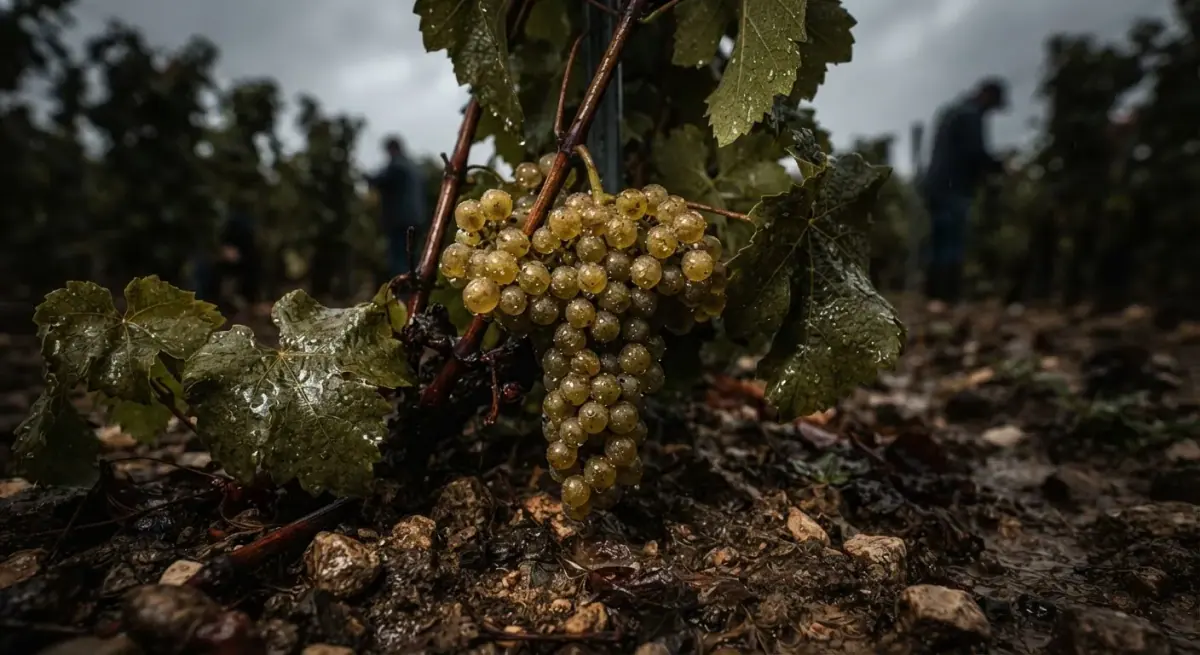
A difficult year in the vineyard, very high acidity and a deliberate choice: under reasoned agriculture we could act when it was needed and bring the crop in. A wine to keep, for several years to come.
Heavy disease pressure
2024 was a difficult year in the vineyard. Mildew pressure was high, and the season ended with grapes that came in very uneven: some parcels were barely touched, others had been hit hard.
At the same time, strict specifications rule out strong curative products. Growers bound by them cannot use what would be effective when the pressure rises. Many of them lost their crop.
None of this is an advertisement for the disease, nor a commercial argument. It is the context of a year of work: a year in which the harvest is played day by day, and in which the way we treat the vines changes directly how much fruit comes in.
Reasoned agriculture, on purpose
We farm under reasoned agriculture: not organic, not biodynamic, not HVE. It is a completely deliberate choice. The reasoning comes down to one sentence: under reasoned agriculture we keep the freedom to use an effective treatment when there is no other option.
In 2024 that freedom made the difference. Two specific products, used at the moment they were needed, allowed us to bring the crop in. They are not part of a routine, and they were not used to treat a crop between two passes either.
The framework is also a calendar. The sequence of plant protection treatments is part of the summer maintenance, along with trimming and the management of creeping weeds. Every pass is prepared in advance and decided at the moment it is necessary.
The rest of the work did not change: soil maintenance remains entirely mechanical, and we will never spread chemicals for nothing. The decision is taken inside a framework, not as an opposition between two methods.
What the year produced
The 2024 wines stand out for very high acidity. That is not a bad vintage in itself: there are still very fine acids in the glass today, and they are the first sign of how well the wine will keep.
But it is clearly a wine to keep. It has to wait several years before it is opened. We do not present it as a wine to drink now, and we would rather say so: this is what the season produced, and a wine is not a matter of instruction.
A wine to keep is not a wine that simply ages well: it is a wine that takes time. The acids of 2024 do not speak in the year they were harvested. They speak after several years, once the wine has settled.
It is the direct counterpoint to a season in which everything was done to bring the crop in. Bringing in a crop, under reasoned agriculture, in a year of heavy disease pressure, is already a great deal.
A method, not a posture
We do not present reasoned agriculture as an alternative to organic or biodynamic farming. It is a way of working, not an argument, and in 2024 we had nothing to prove to anyone.
Nothing that happens after the harvest changed for that year: the ageing was carried out as in every other year, in the same vats, on fine lees. Only the management of the vines had to be adjusted.
What we take from it comes down to one thing: the decision is taken at the moment it is needed, not in advance. In 2024, it was taken.
Key figures
- Disease pressure
- Mildew — the 2024 season
- Method
- Reasoned agriculture, deliberate: not organic, biodynamic or HVE
- Outcome
- Crop brought in, very high acidity
- Wine profile
- A wine to keep — for several years
- Soil maintenance
- 100 % mechanical, 0 % chemical weeding